

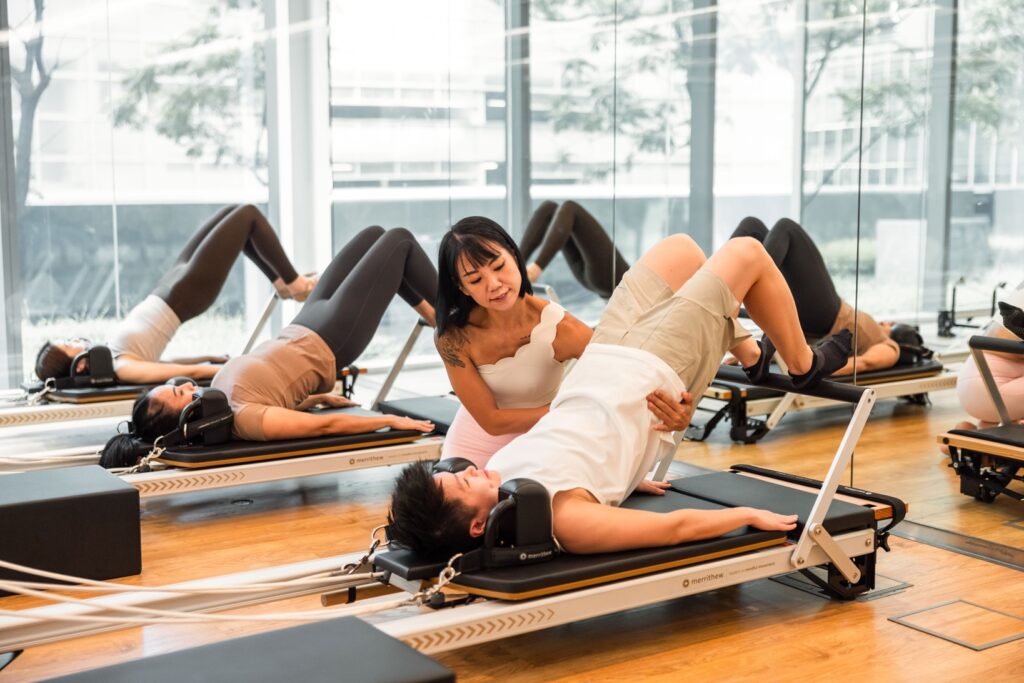
Strength training is often imagined as lifting a fixed weight from the floor or moving a machine through a set path. A reformer creates a different experience. Springs connect the moving carriage to the frame, so resistance changes as the carriage travels and the spring length changes. Body position and movement direction determine whether that spring assists, resists or stabilises the exercise.
This makes reformer pilates Singapore sessions useful for exploring variable-resistance strength with a high degree of control. The aim is not simply to add the heaviest spring combination. Effective training comes from selecting a setup that maintains alignment, creates sufficient muscular demand and allows the full movement to be repeated without losing carriage control.
What Variable Resistance Means on a Reformer
A spring produces more tension as it is stretched further, although the exact behaviour depends on the equipment and spring. The load at the beginning of a carriage movement is therefore not necessarily the same as the load near the end.
The body also experiences the resistance through changing joint angles. A leg press may feel manageable at one point and more demanding at another because leverage changes. The spring is only one part of the load. Limb length, footbar position, straps, carriage distance and tempo all matter.
This differs from a simple free-weight exercise, where the external mass remains constant even though leverage still changes. Neither method is inherently superior. They provide different ways to organise force and progression.
Springs Can Resist and Assist
In reformer footwork, the legs push the carriage away against spring tension. A stronger spring combination generally increases the force needed to move outward, although the exact experience varies with position and range.
During a plank or standing carriage exercise, more spring may make the carriage easier to control because it resists moving away. A lighter spring can create a greater stability challenge even though its absolute tension is lower.
In strap-based arm or leg work, springs provide directional resistance while the carriage supports part of the body. During certain return phases, the spring may help bring the carriage home. The practitioner must still brake the movement rather than allowing the equipment to snap back.
These examples explain why spring colour or quantity cannot be labelled universally as easy or hard. The exercise determines the meaning of the setting.
Strength Depends on Intentional Force
Strength develops when muscles produce force against an appropriate challenge. The reformer can provide that challenge, but only when the setup requires meaningful effort.
A movement performed with such light resistance that the carriage drifts may become primarily a balance task. A setting that is too heavy may shorten the range, alter joint position or encourage momentum. The productive zone sits between those extremes and differs by exercise.
Perceived effort offers one useful guide. Towards the end of a set, the movement should feel challenging while technique remains repeatable. The practitioner should still control the return and maintain breathing without straining unnecessarily.
Four Ways to Progress Without Adding Springs
Increase Time Under Tension
Slowing the outward and return phases increases the time muscles produce force. A three-second return can reveal control deficits hidden by faster movement.
Add a Pause
Stopping the carriage at a chosen point removes momentum and requires isometric control. The pause should occur where the practitioner can remain organised.
Change the Range
A larger range can increase spring stretch and alter leverage. It should expand only while joint comfort and carriage control remain reliable.
Reduce External Support
Changing from two-leg to carefully selected single-leg work, or from two-arm to one-arm straps, increases the coordination and relative load on each side. This is a meaningful progression and should not be rushed.
Footwork as Variable-Resistance Training
Footwork appears simple because the practitioner lies on the carriage and presses against the footbar. In practice, it provides detailed information about lower-limb force and control.
As the carriage moves out, spring tension increases. The knees and hips extend while the feet transfer force into the bar. The return requires the legs to resist the springs and guide the carriage home.
Foot position changes the emphasis. Heels, forefoot and wider or narrower stances alter ankle demand and the orientation of the hips and knees. These variations should be chosen for a reason rather than rotated merely for variety.
Progress can come from smoother deceleration, consistent knee tracking and reduced left-to-right shifting. Adding springs is only one option.
Upper-Body Strength with Straps
Arm work uses straps to transmit spring resistance from the carriage. Because the line of pull changes as the arms move, the challenge is not identical throughout the range.
The trunk must provide a stable base. If the ribs lift, shoulders shift forwards or wrists collapse, the chosen range or resistance may be excessive. Reducing the carriage travel can improve control without making the exercise meaningless.
Unilateral strap work adds anti-rotation demand. The trunk resists being pulled towards one side while the arm moves. This can be useful, but the goal is not to freeze the torso rigidly. The practitioner should maintain an organised position appropriate to the exercise.
Lower-Body and Hip Strength Beyond Footwork
Bridging on the carriage combines hip extension with control of a moving surface. Heavier springs may stabilise the carriage, while lighter settings can increase the demand to prevent movement. The correct selection depends on whether the priority is force production or control.
Standing exercises can load the hips through split-stance or lateral patterns. These require balance and careful equipment setup. The carriage should move only as far as the practitioner can reverse it without gripping or collapsing.
Single-leg work can reveal differences, but it should not be used to diagnose an injury. Some asymmetry is normal, and fatigue, familiarity and coordination can affect performance.
Programming for Measurable Strength
Random variety makes progression difficult to assess. A useful programme repeats selected movement families long enough to improve skill and load tolerance. Changes can then be made deliberately.
Record spring setup, repetitions, range, tempo and perceived effort. Because spring colours can differ between equipment manufacturers, the number and type of springs should be documented within the same studio system rather than treated as universal weight values.
Strength-focused sessions also need recovery. Training the same demanding patterns daily may reduce quality. Frequency should reflect the person’s other exercise, sleep, symptoms and experience.
Who May Benefit from This Approach
The reformer can scale exercises for people who need support as well as those seeking a stronger challenge. The carriage and straps allow many starting positions, but adaptability does not make every exercise appropriate for everyone.
People with pain, recent surgery, pregnancy-related considerations, osteoporosis or other health concerns may need individual clinical advice and instructor modifications. Claims that the equipment treats a condition should be avoided.
At Yoga Edition, progressive reformer programming can help practitioners understand how resistance, assistance and stability change across exercises. Instructor observation also helps ensure that a spring adjustment serves the movement goal rather than simply making the machine feel heavier.
Signs of an Appropriate Training Load
The carriage moves smoothly without crashing into the stopper. The practitioner can maintain the intended joint position and complete the return with control. Effort rises across the set, but sharp pain or breath holding does not.
The following session also provides information. Ordinary muscular fatigue may be expected, while persistent joint irritation, worsening pain or unusual symptoms indicate that the load or exercise should be reassessed.
Conclusion
Variable resistance makes reformer strength training more complex than counting springs. Tension changes with carriage travel, and the same setting can assist one exercise while challenging another.
Effective progress comes from matching spring choice with position, range, tempo and control. When those variables are tracked consistently, the reformer becomes a precise strength-training system rather than a collection of constantly changing movements.
Frequently Asked Questions
Do heavier springs always build more strength?
No. Heavier springs increase resistance in some exercises but can make the carriage more stable in others. The exercise direction and training goal determine the effect.
Can reformer sessions replace all strength training?
They can contribute meaningfully to strength, but other methods may be useful for specific performance or maximum-force goals. A balanced programme should match the individual’s needs.
Why does a lighter spring sometimes feel harder?
Less spring tension can provide less carriage stability. The practitioner may need more muscular control to prevent unwanted movement.
How should progress be recorded?
Track the exercise, spring combination, repetitions, range, tempo and perceived effort. Use the same equipment system for reliable comparisons.
Should the carriage return quickly?
No. A controlled return keeps muscular tension and prevents the carriage from striking the stopper. Speed should be intentional.
How often should strength-focused reformer sessions occur?
Frequency depends on training experience, other exercise and recovery. Allow enough time for movement quality and muscular readiness to return before repeating demanding work.